

Young Sherlock review: an exciting vision of the detective's early years

There was a time when the release of a new trailer for a television series simply created buzz for that particular property. In those glory days of old, audiences would just happen to see an advertisement alerting them to the fact that the premiere of a new series was just around the corner. “That seems interesting,” they would say to themselves. “Perhaps I’ll give that a try”.

Times have changed. In this modern era when television shows look like movies (often with budgets to match) and viewers have the option to stream anything they wish to at any time, the buzz doesn’t merely revolve around the series proper; the trailer itself has been built up to be an event unto itself, with audiences eagerly anticipating the release of a thirty-second to two- or three-minute long supercut of an upcoming show’s highlights.
When the trailer for the Guy Ritchie produced Young Sherlock dropped on February 5, it very quickly broke a record, becoming Prime Video’s most-watched trailer for an original series ever, with 223,000,000 views in just seven days. That’s nothing to sneeze at, in a world where new series and movies based on Arthur Conan Doyle’s most famous character are released several times a year.
There have by now been two trailers, which show Sherlock at Oxford, meeting new friends (i.e. James Moriarty), solving mysteries, getting arrested, nearly making a fashion faux pas in the form of a certain hat, and running. Lots of running. But as action-packed and entertaining as the trailers are, is the show really worth watching, or is this one of those situations when all the good parts appear in the ads and the rest of the show is a dud?
When we first meet Sherlock (Hero Fiennes Tiffin) he is in prison, getting pummelled by a fellow inmate. The action is typical Guy Ritchie fare, reminding one of Ritchie’s 2009 film Sherlock Holmes, at the same time doing its own thing. The scene sets up the series perfectly, assuring the viewer that there will be plenty of action, but that Sherlock, a former pugilist in the canonical stories, still has plenty to learn.
Once Sherlock’s brother Mycroft (Max Irons) bails him out of his predicament and gets him a menial job at Oxford (not enrolling him as a student, as he had expected) the series begins to roll. Sherlock is a brilliant but shiftless young man, searching for his place in life and still blaming himself for his young sister Beatrice’s death when the three siblings were children.
When he meets the more-worldly James Moriarty (Dónal Finn) and is framed first for stealing a valuable scroll and then for murder, he finds himself on the run from the authorities, including a young constable name Lestrade (Scott Reid) and a deerstalker-wearing, pipe-smoking detective named Fitget (Simon Delaney).
As promised by the trailer, the series is action-packed, with at least one chase and/or fight scene in every episode. There are certainly mysteries for Sherlock to put his faculties to work on, but the series as a whole could not really be called a mystery series. It’s more of a Boys Own adventure, with Sherlock and James running through Oxford trying to clear the former’s name while big brother Mycroft unsuccessfully attempts to keep him out of trouble.
The turning point comes when Sherlock breaks his mother Cordelia (Natascha McElhone) out of the institution where she’s been kept ever since her break down after losing her beloved daughter Bea. McElhone’s performance, like that of the rest of the cast, is pitch perfect as she goes from portraying a delusional madwoman to a relatively sane, adventurous, and just a tad mischievous woman ready to team with her sons to get to the bottom of the greater mystery underlying the season.
Fiennes Tiffin, Finn, and Irons are all well-cast in their respective roles, as is Zine Tseng, who plays Princess Gulun Shou’an, a character who never appeared in the original 60 stories by Conan Doyle, but who plays a pivotal role in the series, albeit one that the audience won’t fully understand until the later episodes.
Finn’s portrayal of James Moriarty is excellent, as is the writing for the character, and his may have been my favourite arc of the season. When he and Sherlock shake hands for the first time, one can feel fate’s wheels begin to turn and when, later in the season, he kills someone for the first time while defending a friend, Finn’s face tells you all you need to know about how it makes him feel. This isn’t just an origin story for Holmes, but also his greatest enemy.
And speaking of Holmes, Fiennes Tiffin is completely believable as a directionless young Sherlock, containing as-yet-untapped potential, only being held back by his (admittedly flawed) memory of Bea’s death. (Food for thought: could Sherlock’s late sister’s name be a subtle nod to the fact that Holmes will eventually retire to Sussex to keep bees?).
The series isn’t all fast-paced action. Showrunner Matthew Parkhill is known for his complex characters and that skill is displayed here, along with lots and lots of humour, which is practically a necessity for a family show of this sort.
It is nearly impossible to discuss the last four episodes of the eight-episode season without giving away some major spoilers. In episode five, the revelations begin to come hot and heavy. Parkhill told me that was his favourite episode, and I have to agree. Throughout the first half of the season, I found the series fun and entertaining. It was episode five that flipped it to riveting.
While a Victorian adventure throughout, there are some specific episodes that stand out: one episode in the bottom of the season felt like a heist film with a little James Bond mixed in, and parts of the very last episodes seemed to take inspiration from Indiana Jones. The genre nods don’t feel out of place; on the contrary, they seem to be a natural progression of the story, keeping the series fresh and vital near the end, rather than making one feel like they’re watching the same Victorian rehash over and over again.
If I had one quibble, it would be of the Easter eggs. Some of them were clever and intriguing (i.e. Sherlock’s first introduction to the idea of the Baker Street Irregulars) while others felt a little shoe-horned in. The most egregious of these was the character of Fitget (no offence to actor Simon Delaney, who does a serviceable job with what little he’s given.) The character is only in two or three episodes, and his only reason for existing seems to be to inspire Sherlock’s future sense of style. He’s only marginally more intelligent than Lestrade, and his presence doesn’t add anything to the plot.
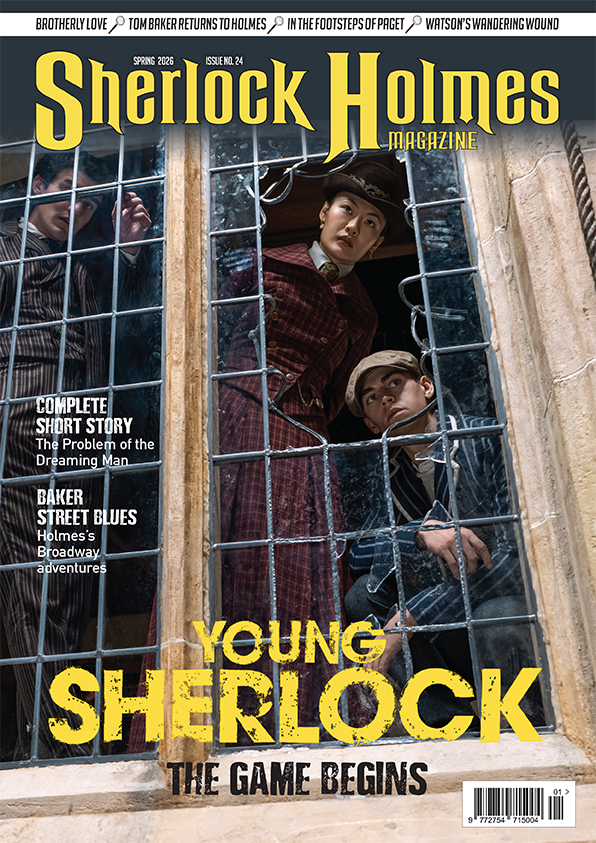
Overall, however, I found the series to be my favourite of the “Young Sherlock Holmes” film and television properties (including the beloved Young Sherlock Holmes [1985], which I do enjoy) and it’s at least neck-and-neck with last year’s Sherlock & Daughter television series, if not slightly ahead, in my estimation.
Guy Ritchie’s Young Sherlock is an exciting vision of the early years of the World’s Only Consulting Detective, with lots of expectation-subverting twists and turns and never a dull moment. Great for both younger viewers and adults. Those who know nothing about Sherlock Holmes (an ever-diminishing demographic), those who are Holmes-curious, and those who sleep with a copy of the canon under their pillow will all find something to enjoy in the series. A second season hasn’t been greenlit yet, but the smart money says it will be.
All eight episodes of Young Sherlock will be streamable worldwide on Prime Video beginning this Wednesday, March 4 and you can read my in-depth coverage of the series, including interviews with Parkhill, Fiennes-Tiffin, Finn, and Tseng in the latest issue of Sherlock Holmes Magazine, issue #24.


